


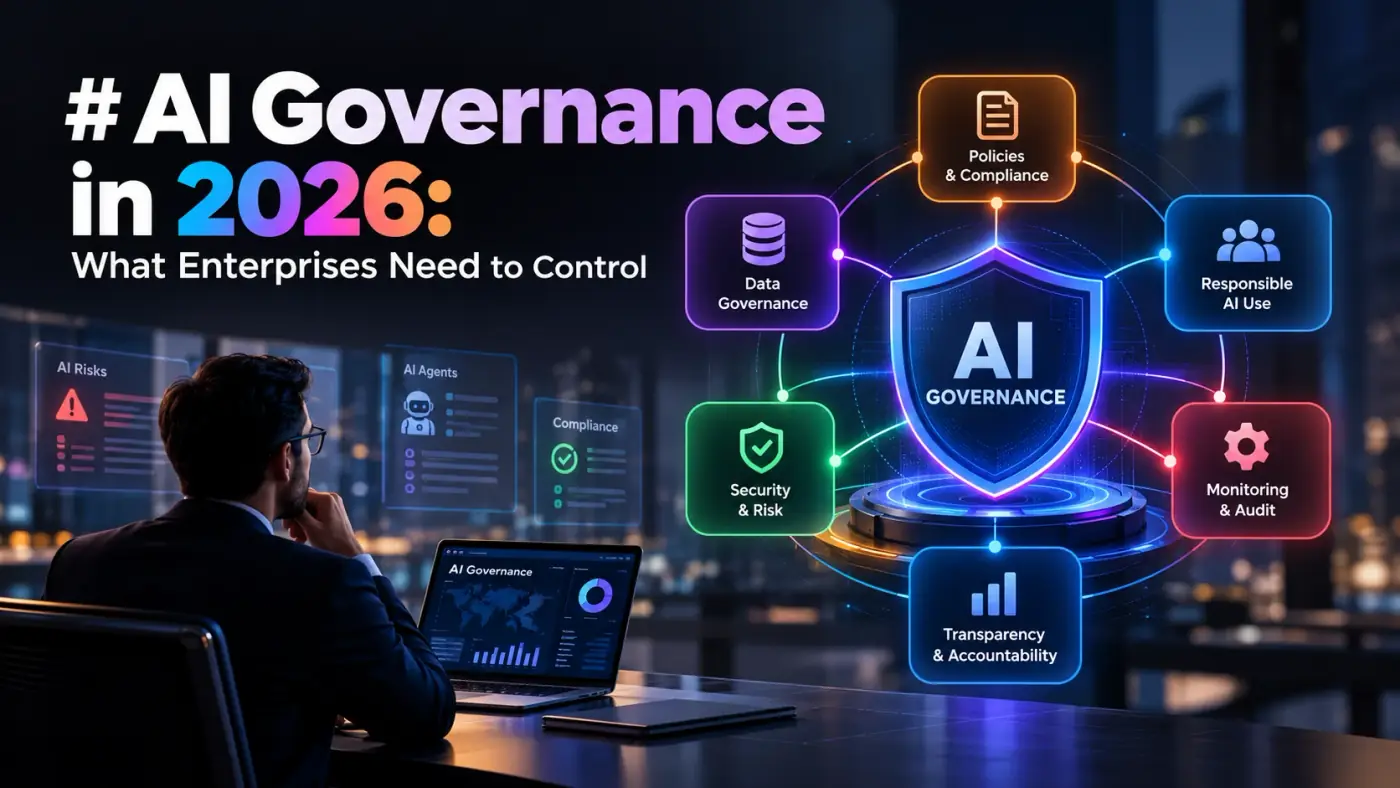
Artificial intelligence has moved beyond experimentation. In 2026, enterprises are using AI agents, generative AI applications, copilots, predictive models, and automated decision systems across business operations.
But as AI becomes more autonomous, another question is becoming increasingly important:
Who controls the AI?
Enterprise AI governance is no longer just about compliance or creating an internal AI policy. Organizations need a practical framework for controlling what AI systems can access, what they can do, what data they can use, how decisions are made, and who remains accountable.
The challenge is particularly significant as businesses adopt multiple AI models, third-party AI platforms, and autonomous agents across departments. This makes AI governance one of the most important enterprise technology priorities in 2026.
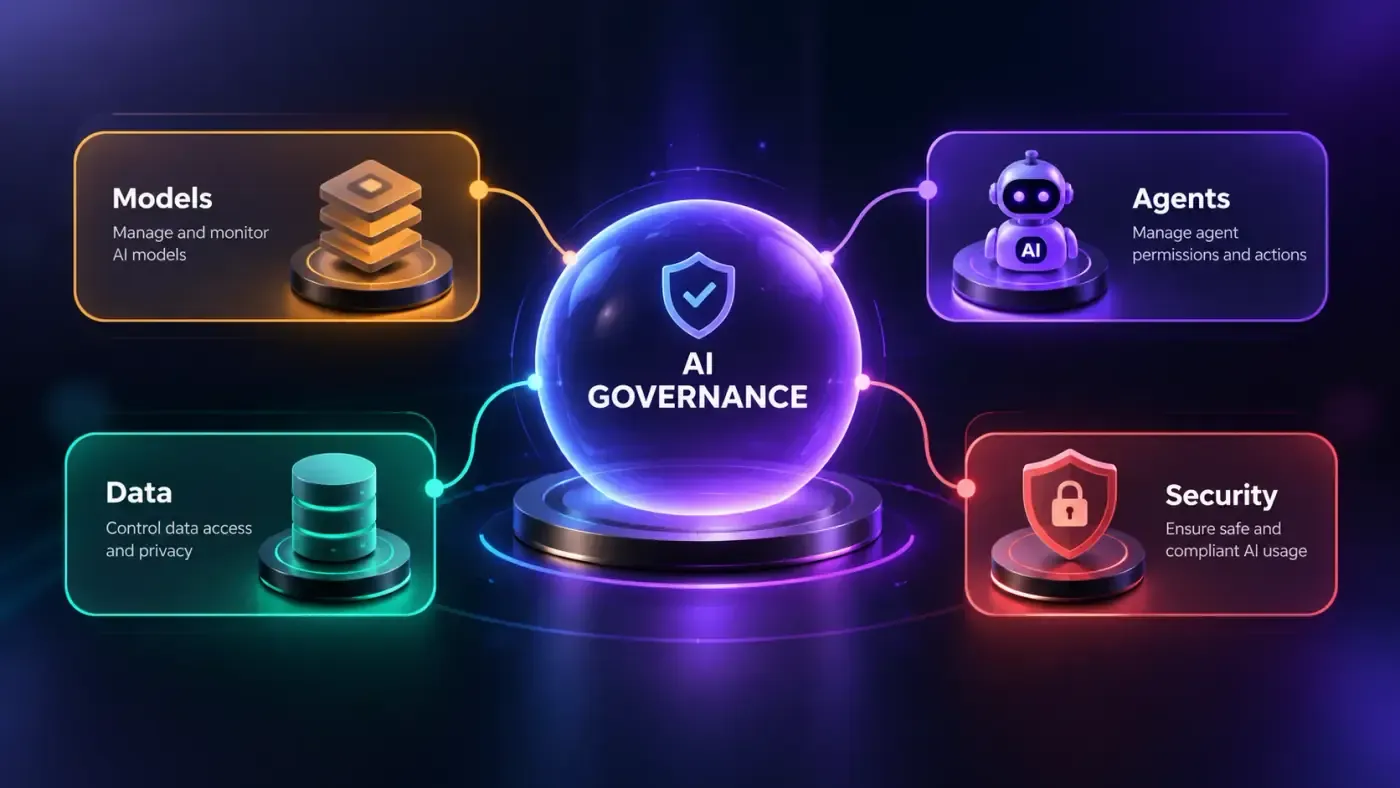
Enterprise AI governance creates a control layer across models, data, agents, security and decisions.
What Is AI Governance?
AI governance is the set of policies, processes, controls, technologies, and responsibilities an organization uses to manage AI throughout its lifecycle.
- AI model selection and approval
- Data access and privacy
- Security and identity
- Model monitoring
- Human oversight
- Risk management
- Regulatory compliance
- AI-generated content
- Third-party AI providers
- AI agent permissions
- Model and application lifecycle management
Traditional software governance often focuses on applications, users, and infrastructure. AI governance adds another layer: controlling how intelligent systems behave and make decisions.
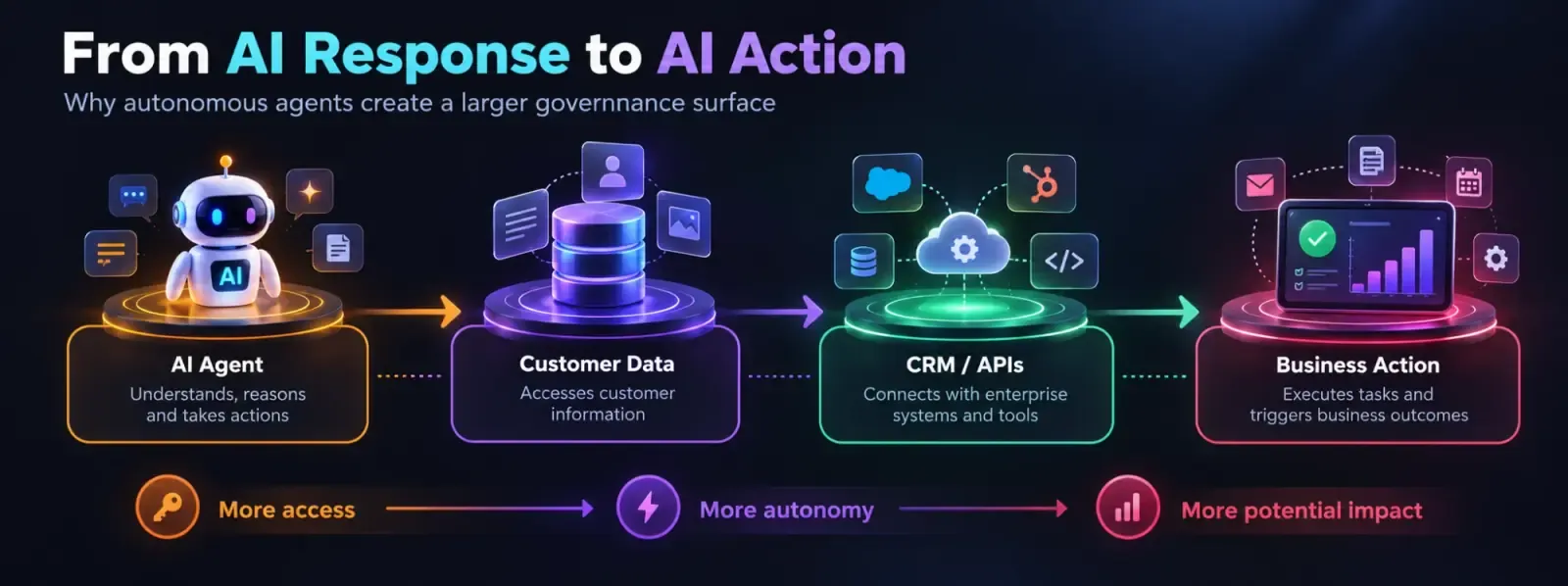
As AI moves from generating responses to taking actions, its governance surface expands.
Why AI Governance Matters More in 2026
The biggest change is the shift from AI that simply generates responses to AI that can take actions. An AI agent might read customer records, search internal knowledge bases, send emails, create tickets, update CRM records, execute workflows, call APIs, generate reports, make recommendations, and trigger downstream business processes.
This creates a much larger risk surface. If an AI system has access to sensitive information and the ability to take action, a mistake, compromised credential, malicious prompt, or poorly configured permission can have real business consequences.
Is this AI model accurate?
What is this AI allowed to do?
The 7 Things Enterprises Need to Control
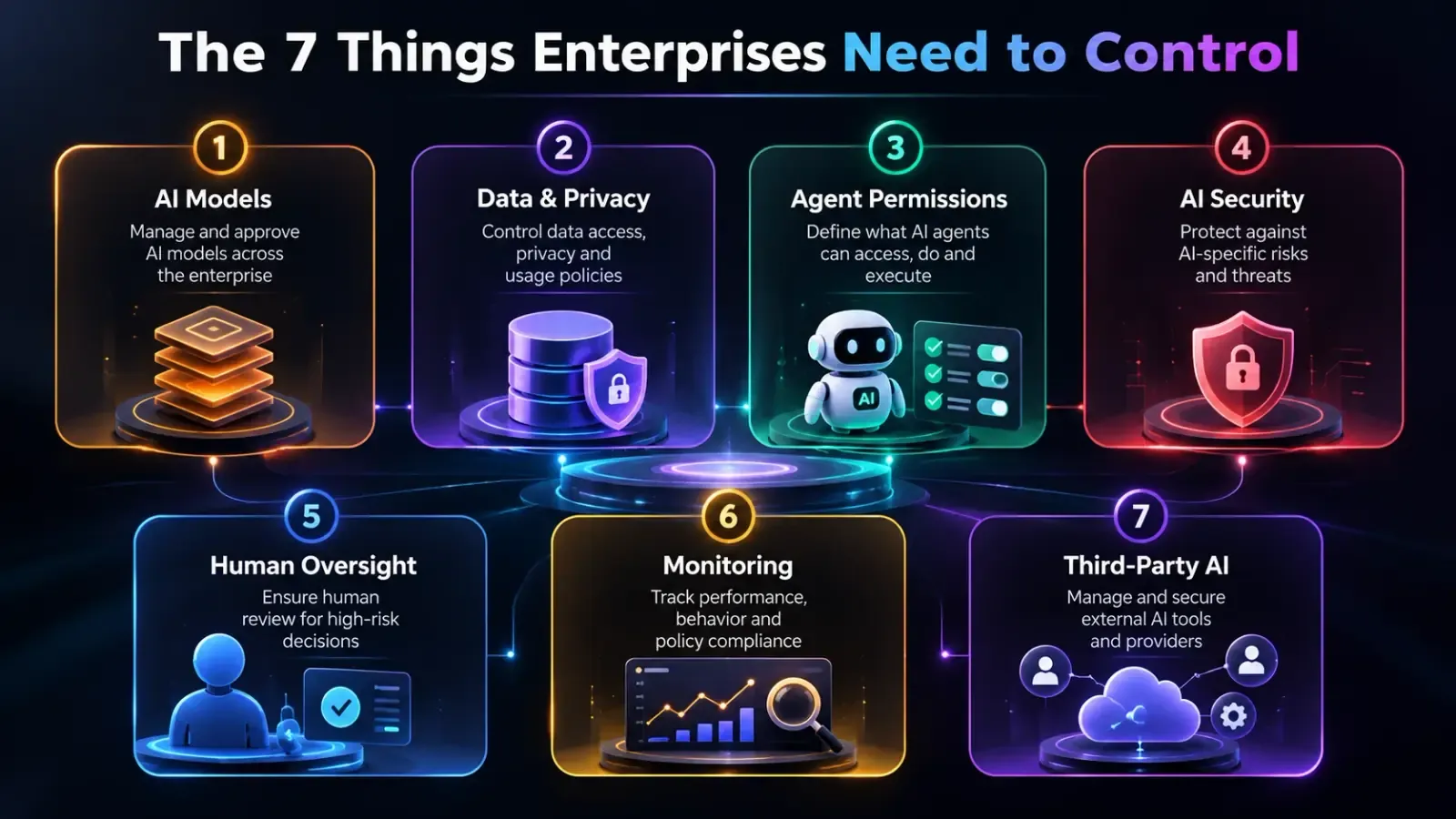
Seven governance areas enterprises should control as AI adoption expands.
1. AI Models and Model Selection
Enterprises increasingly use multiple AI models from different providers. Organizations need visibility into which models are being used, who approved them, where they are deployed, what data they process, what vendors provide them, their security requirements, how performance is evaluated, and what happens if a model becomes unavailable. A centralized AI model inventory helps teams understand the AI landscape.
2. Data Access and Privacy
AI systems are only as secure as the data they can access. Enterprise AI applications may interact with customer information, employee records, financial data, healthcare information, intellectual property, source code, contracts, and internal documents. Governance should define exactly which data an AI system can access and why. Give AI systems only the data access they need to perform their assigned task.
3. AI Agent Permissions
AI agents can dynamically determine what actions to take based on context. A sales agent could read a CRM, research a prospect, create an email, send it, and update the CRM. Enterprises should define what an agent can read, change, execute, and what requires human approval.
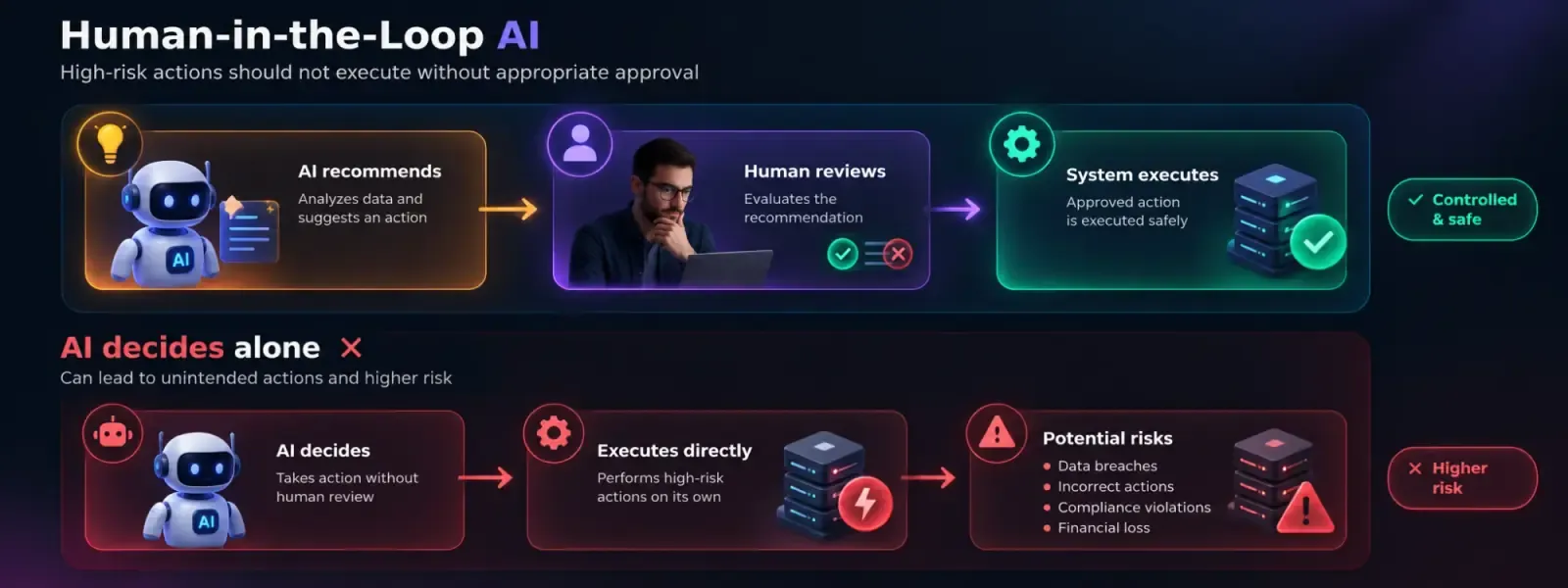
A human-in-the-loop workflow adds approval before high-risk AI actions are executed.
4. AI Security
AI introduces risks including prompt injection, data leakage, model manipulation, excessive agent permissions, insecure integrations, malicious tool calls, sensitive information disclosure, supply-chain risks, and unauthorized AI usage. AI governance should work closely with the organization’s cybersecurity strategy.
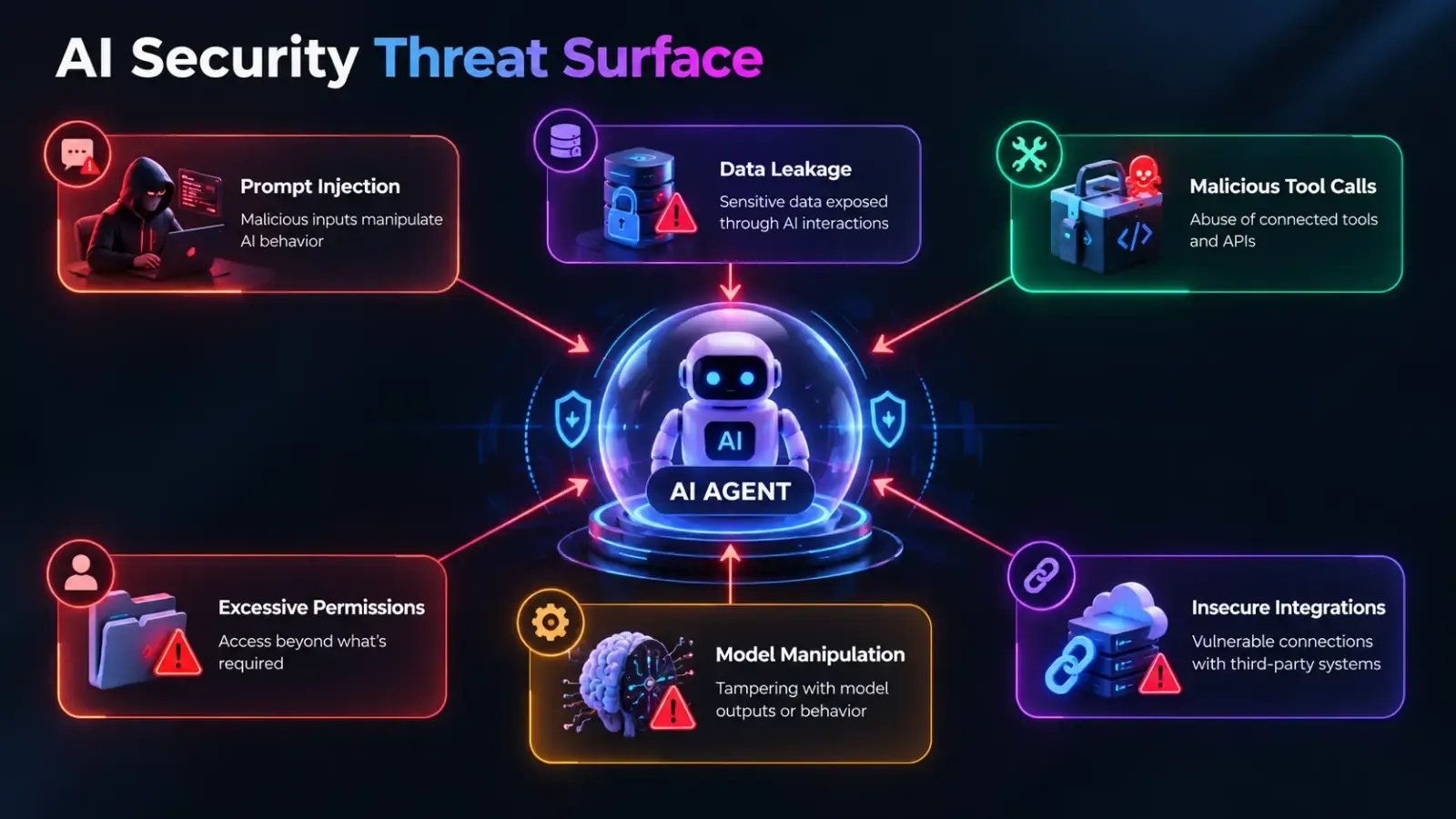
Common AI security risks that governance programs need to address.
5. AI Decision-Making and Human Oversight
Not every AI decision should be treated equally. Marketing recommendations may be low risk, while healthcare, financial services, employment, insurance, legal, and credit decisions can have significantly higher consequences. The higher the potential impact of an AI decision, the stronger the governance should be.
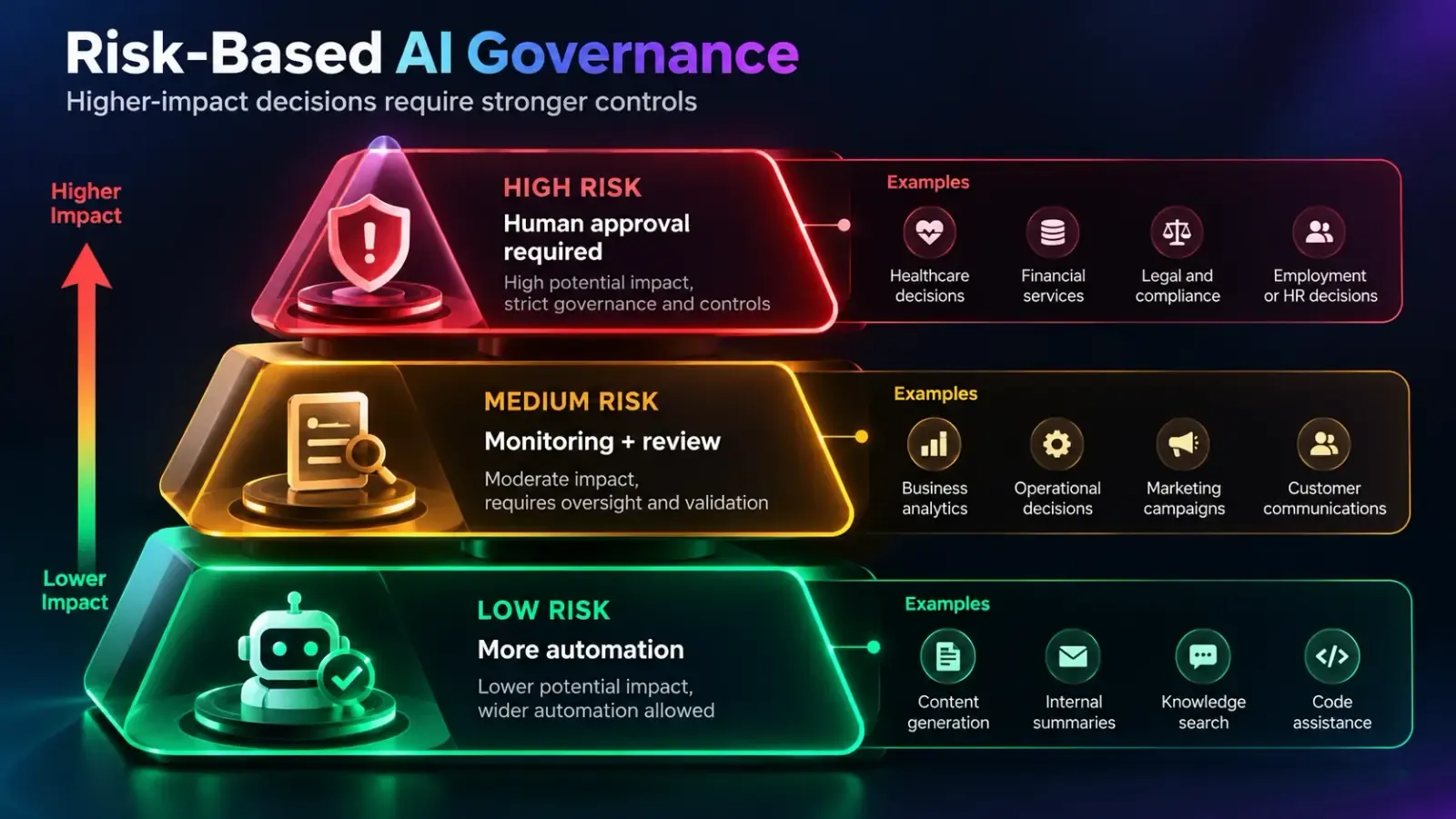
Governance controls should become stronger as the potential impact of an AI decision increases.
6. AI Monitoring and Auditability
Deploying an AI system is not the end of governance. Organizations need continuous visibility into model performance, accuracy, hallucinations, security events, data access, agent actions, API usage, cost, user activity, policy violations, and drift in model behavior. Audit trails should show who used the AI, what data it accessed, what it generated, what actions it took, and what happened afterward.
7. Third-Party AI and Shadow AI
Employees may use public AI tools to summarize documents, write code, analyze spreadsheets, create presentations, generate marketing content, or process customer information. This can create Shadow AI. The goal should be controlled AI adoption, supported by approved tools, clear policies, data-handling guidelines, security controls, training, approved use cases, and monitoring.
A Practical AI Governance Framework for Enterprises
A strong AI governance program can be organized into five layers:
1. Discover
Identify all AI applications, models, agents, vendors, and use cases across the organization.
2. Classify
Assess each AI system based on its data access, business purpose, autonomy, and potential risk.
3. Control
Apply appropriate permissions, security policies, data controls, human approvals, and usage restrictions.
4. Monitor
Continuously monitor AI behavior, performance, security, cost, and policy compliance.
5. Improve
Regularly review AI systems and update policies as models, regulations, threats, and business requirements evolve.
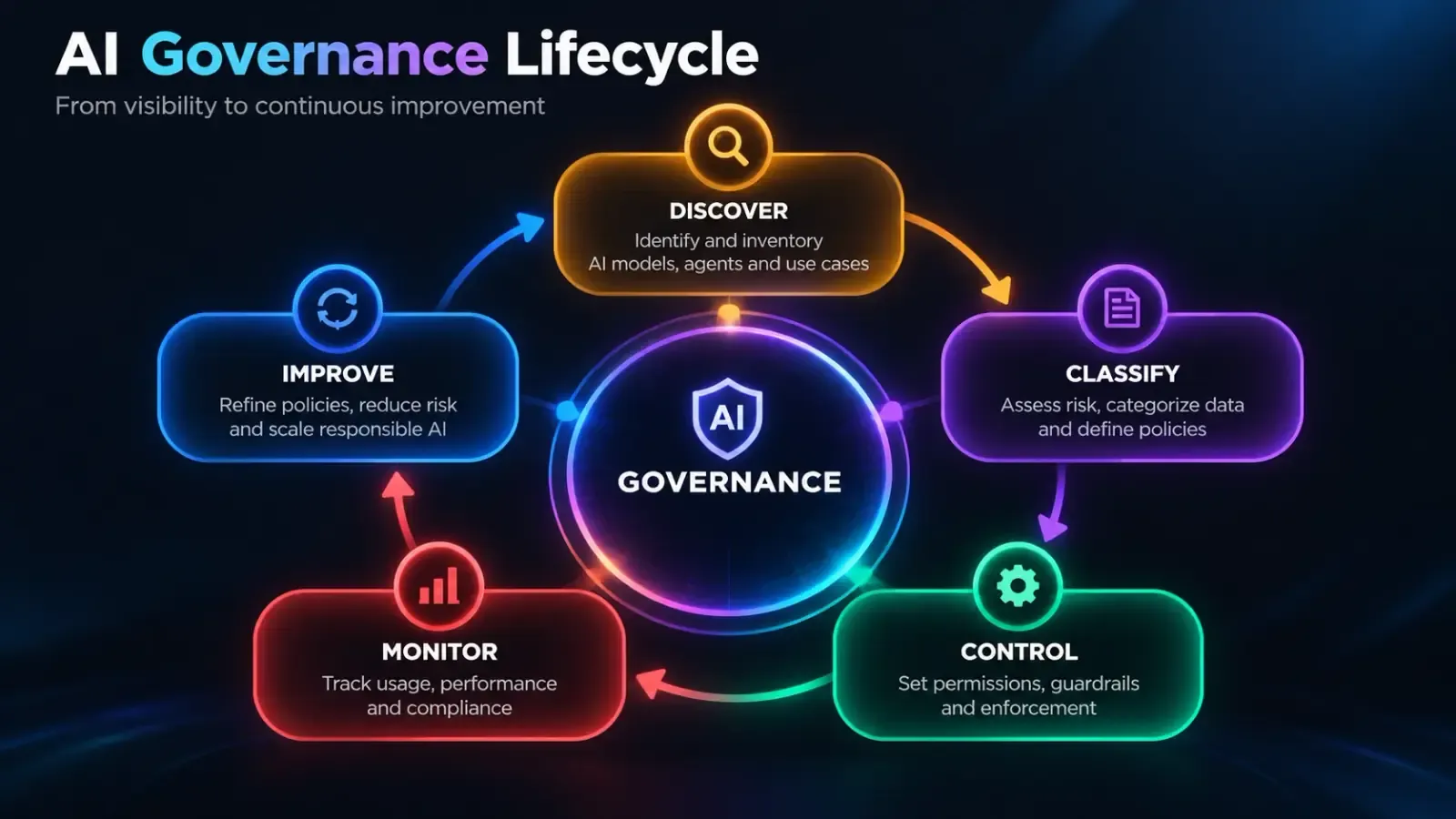
A continuous AI governance lifecycle: Discover, Classify, Control, Monitor, and Improve.
AI Governance Should Not Become an Innovation Bottleneck
Governance does not have to slow down AI adoption. The best governance frameworks make it easier for employees and development teams to use AI safely.
- Approved models
- Secure AI gateways
- Identity and access controls
- Data protection
- Monitoring
- Audit logging
- Policy enforcement
- Human approval workflows
This allows teams to innovate while maintaining enterprise-level control.
The Future of AI Governance Is Agent Governance
The next stage of enterprise AI will not simply be about managing models. It will be about managing AI agents and the actions they can perform.
- Which agents exist?
- What systems can they access?
- What decisions can they make?
- What actions can they execute?
- Who owns each agent?
- When should a human intervene?
- How do we stop an agent if something goes wrong?
This represents a shift from AI model governance toward AI system and agent governance.
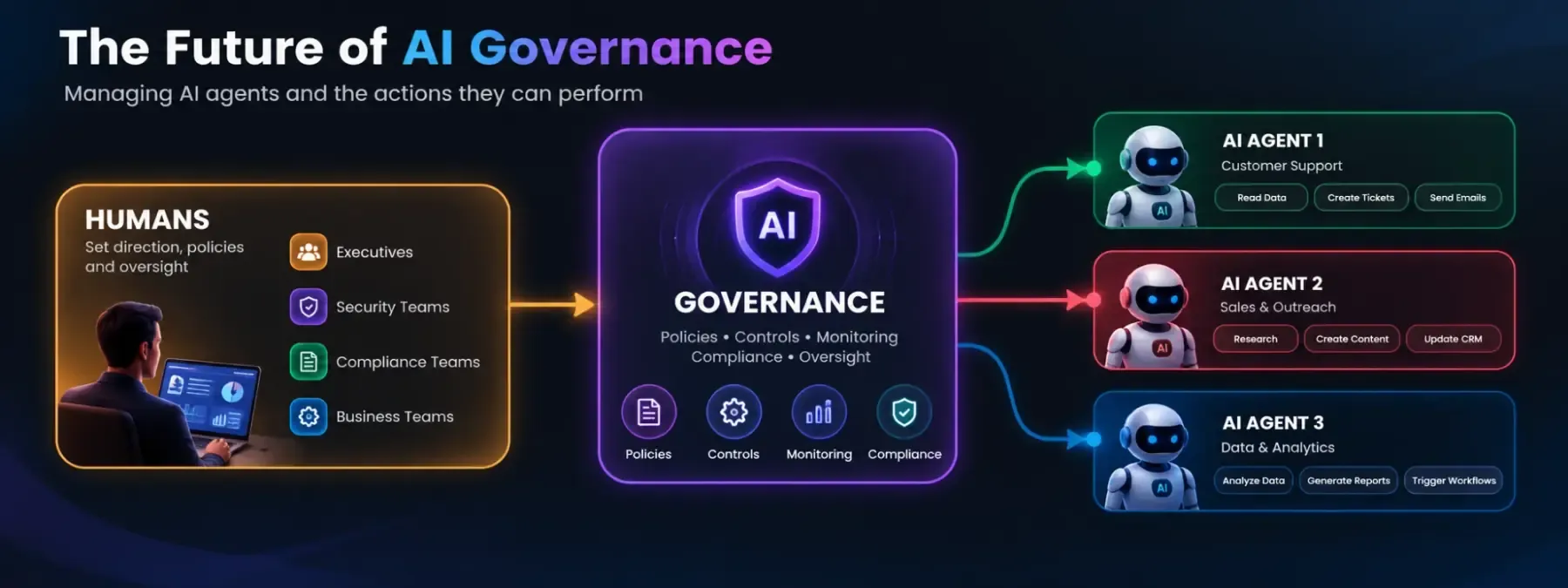
The future of enterprise AI governance: humans, AI agents, and business systems operating within a controlled framework.
What Enterprises Should Do Now
Build an AI inventory
Know where AI is being used across the organization.
Establish an AI risk classification
Separate low-risk experiments from high-impact AI applications.
Define data-access policies
Make sure AI systems cannot access more information than necessary.
Introduce agent permissions
Treat AI agents as digital identities with defined privileges.
Create human-approval workflows
Require human intervention for high-impact or irreversible actions.
Monitor AI continuously
Track performance, security, behavior, and policy compliance.
Establish an AI governance committee
Bring together technology, security, legal, compliance, data, and business stakeholders.
Conclusion
AI governance in 2026 is no longer simply about writing an acceptable-use policy for generative AI. It is about creating a control layer for an increasingly autonomous digital workforce.
As enterprises move from AI assistants to AI agents, governance must evolve alongside them. The organizations that succeed will not be those that use the most AI. They will be the ones that can scale AI safely, control its access, monitor its behavior, and maintain accountability while continuing to innovate.
The future of enterprise AI isn’t just intelligent. It needs to be governed.

💬Discussion & Notes
Comments powered by Garrul.