


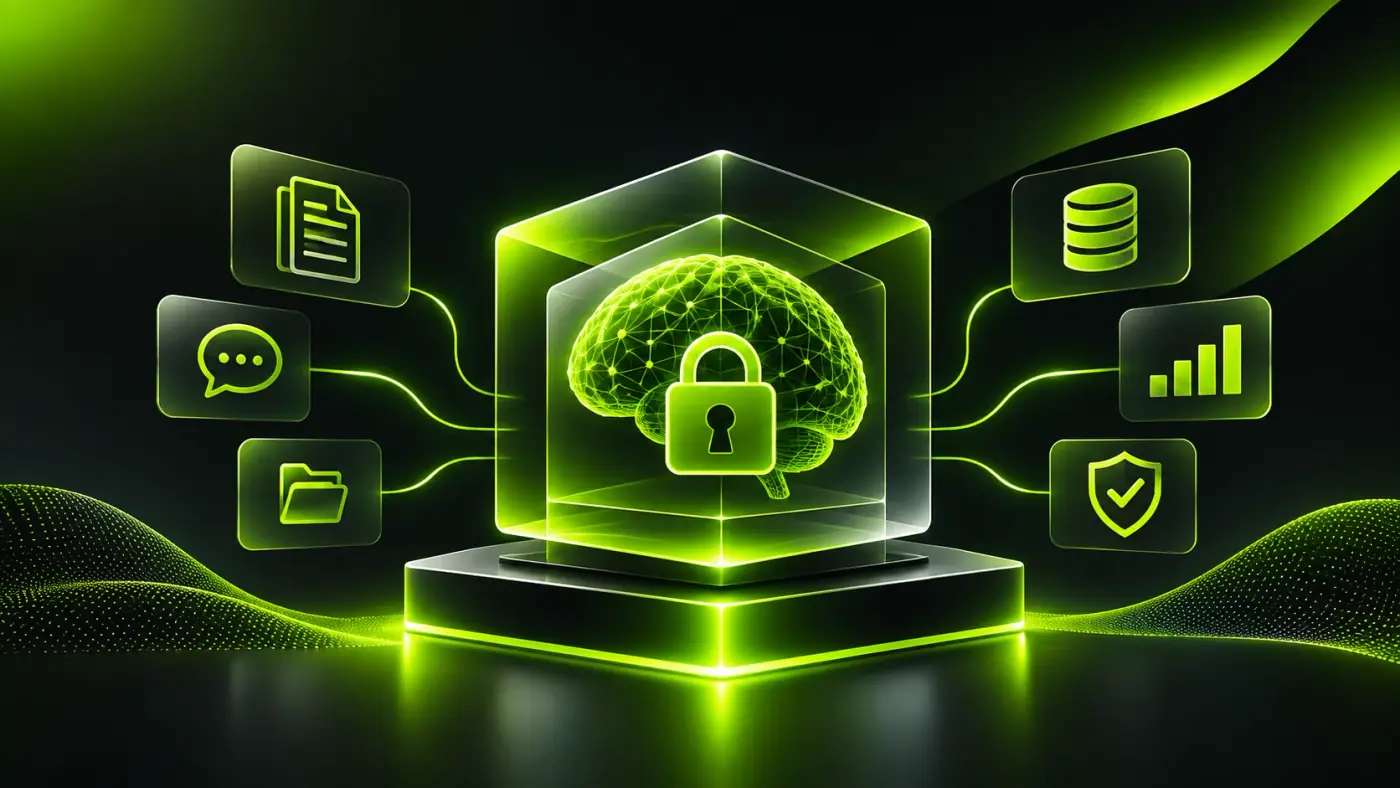
If data is your critical asset and competitive edge, it shouldn’t leave your network to be processed by an intelligence provider you don’t control.
That holds for a 1-person company and a 100,000-person company alike. The scale changes, but the principle shouldn’t.
The case for keeping AI close to your data is getting stronger, as we explored in Private AI vs. Public AI. The harder question is the practical one.
So what does it take to build a private AI?
1. Hardware
Right-sized compute decides which models you can run, how many users you can serve and what it costs.
Too little, and you are limited to small models or long queues. Too much, and expensive hardware sits idle. The right size depends on the models you need, the number of concurrent users and the workloads they run.
2. Inference Setup
Own the serving stack inside your network: hosting, model choice and tuning to your hardware.
Running models privately means the whole path from prompt to answer stays under your control. That includes how models are hosted, which models you choose for each task, and how they are configured to get the most out of the hardware you have.
3. Inference Performance
Private can’t mean slow. If it lags under real load, people stop using it. This is the space that defines the ROI.
A private AI that works in a demo but struggles when the whole team logs in on Monday morning will not be adopted. Performance under real, concurrent load is what turns an investment in private AI into everyday use.
4. A Knowledge Base for Structured and Unstructured Data
Documents and databases alike, connected to internal systems through RAG ingestion and real-time tool calling, so the AI works on live data, not stale copies.
Most enterprise knowledge lives in two forms: unstructured content such as documents, emails and wikis, and structured data in databases and business applications. A useful private AI needs both, and it needs them current.
5. The LLM as a Stateless Thinking Machine
The model reasons, plans and calls tools. Memory, context and state live in the platform around it, making the LLM a dependable backbone for agentic orchestration.
Treating the model as a stateless reasoning engine keeps conversations, history and project context in systems you own. As we covered in Switching AI Models Is Easy. Switching Memory Isn’t., that is what keeps your work intact when the model changes.
6. Data From Many Integrations
Databases, SharePoint, Microsoft 365, Google Drive, Slack, Teams, SAP, CRM. Private AI is only as useful as the data it can reach.
The value of private AI grows with every system it can securely connect to. An assistant that can only see one folder of documents will answer one kind of question; one that reaches across the business can support real work.
7. Fast, Contextual Retrieval
Retrieval has to be relevant to the prompt and fast. Aim for a time to first token (TTFT) under a second, and five seconds at most.
Finding the right information is only half the job. If users wait too long for the first words of an answer, the experience breaks down, no matter how good the answer eventually is.
8. An Intelligence Layer Abstracted From the LLM
Core features operate over the knowledge base, not a specific model. LLMs become plug and play.
When search, summarization, agents and workflows are built on your knowledge layer rather than tied to one model, you can adopt better models as they appear without rebuilding everything. Our Model Portability Playbook covers this architecture in more detail.
9. Portability and Scale
It runs on hardware of your choice and scales with demand, without re-architecting.
Requirements change. A platform that starts on a single server should be able to grow across a cluster, move between on-premises and private cloud, and handle more users and more data without a redesign.
10. Data and Security as First-Class Citizens
An unbreakable wall around the data, from day one, not an afterthought, even when the system is 100% private.
Keeping AI inside your network is the starting point, not the finish line. Access controls, permissions, audit trails and monitoring still matter, especially as AI agents begin to take actions. Our guide to Zero Trust for AI Agents explains how to apply them.
Bringing It Together: DeepSilo
With all this in mind, we built DeepSilo at Periscope Technologies, a private AI lab in a box built on NVIDIA DGX:
 Built on

A private AI platform with intelligence for any hardware, any scale, any volume, any integration points and, most importantly, any domain or use case.
Want to bring private AI to your own clients? Explore the DeepSilo Partner Program.
Private AI Is a Platform Decision
Private AI isn’t a model or a box. It’s a platform decision, and it keeps your data yours.
Getting there takes more than installing a model on a server. It takes the right hardware, a fast serving stack, a knowledge layer connected to live data, a model-independent intelligence layer, and security designed in from the first day.
How is your organization deciding where your data goes when you use AI?
See what private AI looks like on your data
Book 15 minutes with a Periscope engineer. We’ll walk through DeepSilo and how a private AI platform would fit your hardware, integrations and use cases.
Book 15 minutesNVIDIA and DGX are trademarks of NVIDIA Corporation.

💬Discussion & Notes
Comments powered by Garrul.