



Artificial Intelligence (AI) is transforming how businesses operate, compete, and deliver value to customers. From AI-powered chatbots and intelligent automation to predictive analytics and autonomous AI agents, organizations are exploring new ways to improve productivity and accelerate growth.
But there is a challenge.
Many businesses are investing in AI tools without first understanding how those tools align with their business objectives.
Some implement AI chatbots because competitors are using them. Others purchase AI-powered software to automate operations without evaluating their existing workflows. While these investments may deliver short-term benefits, they don’t always translate into meaningful business outcomes.
The problem isn’t a lack of AI tools. It’s a lack of AI strategy.
Before investing in AI technology, businesses need a clear roadmap that defines what they want to achieve, where AI can create value, how it will integrate with existing systems, and how success will be measured.
This is where a well-defined AI strategy becomes essential.
1. Why Businesses Are Rushing Into AI Without a Strategy
The growing availability of AI platforms has made adoption easier than ever. Businesses can now access generative AI, automation platforms, machine learning models, and AI-powered business applications with relatively little technical effort.
However, adopting AI without a clear direction can create several challenges:
- Unnecessary technology spending: Businesses invest in tools that don’t address their actual operational challenges.
- Disconnected systems: New AI applications operate independently instead of integrating with existing business platforms.
- Data security risks: Employees may unknowingly expose confidential business information through unauthorized AI tools.
- Low adoption: Employees struggle to understand how AI fits into their daily responsibilities.
- Unclear ROI: Organizations cannot determine whether their AI investments are delivering measurable business value.
Instead of adopting AI simply because it is trending, businesses should identify where it can solve real problems.
2. Start With Business Problems, Not AI Tools
An effective AI strategy begins with understanding business operations.
Before selecting a technology, organizations should identify repetitive processes, operational bottlenecks, customer experience challenges, and areas where better data insights could improve decisions.
For example:
| Business challenge | Potential AI solution |
|---|---|
| High customer support workload | AI-powered customer support agents |
| Manual lead qualification | AI SDR and prospecting agents |
| Time-consuming document processing | Intelligent document automation |
| Disconnected business information | AI-powered knowledge assistants |
| Slow IT support response | AI-driven IT service desk |
| Limited business insights | Predictive analytics and AI reporting |
This approach ensures that every AI investment has a defined business purpose.
3. Build a Clear AI Adoption Roadmap
AI transformation should not happen overnight. Businesses need a structured implementation roadmap that balances immediate opportunities with long-term objectives.
A practical AI adoption strategy can include four stages.
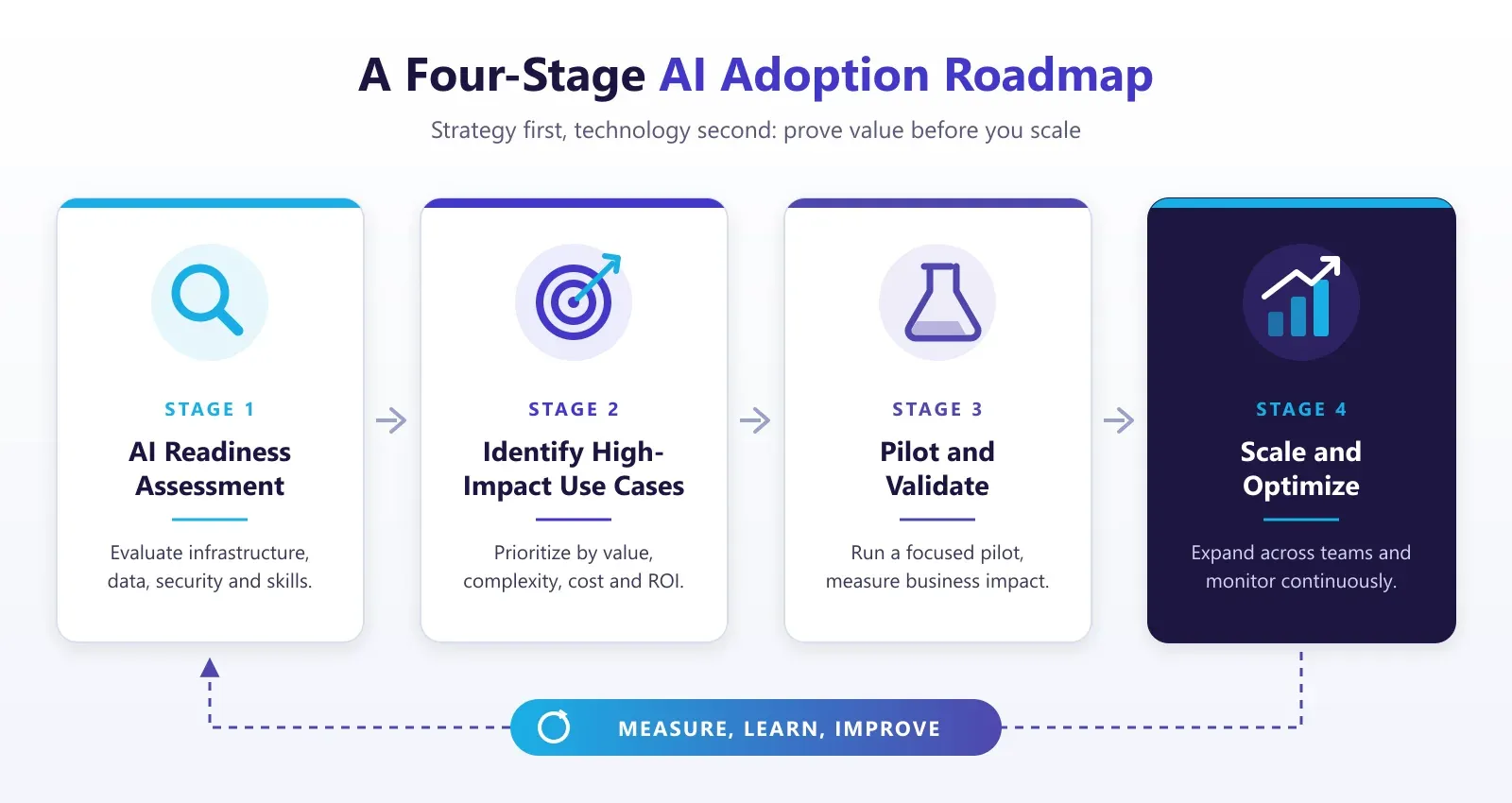
A four-stage AI adoption roadmap: assess readiness, prioritize use cases, prove value in a pilot, then scale, measuring and improving at every step.
Stage 1: AI Readiness Assessment
Evaluate existing infrastructure, business applications, data availability, security requirements, and employee capabilities.
Stage 2: Identify High-Impact Use Cases
Prioritize opportunities based on business value, implementation complexity, cost, and expected return on investment.
Stage 3: Pilot and Validate
Start with a focused AI implementation. Measure its performance, gather feedback, identify limitations, and validate the business impact.
Stage 4: Scale and Optimize
Expand successful AI solutions across departments, integrate them into enterprise workflows, and continuously monitor their performance.
This phased approach helps reduce implementation risks while creating a foundation for sustainable AI adoption.
4. Data Readiness Is the Foundation of Successful AI
AI systems depend on data to generate insights, answer questions, automate workflows, and support decision-making.
However, many organizations operate with fragmented, outdated, or inconsistent data spread across multiple applications.
Before implementing AI, businesses should evaluate:
- Data quality and accuracy.
- Data accessibility across systems.
- Existing databases and integrations.
- Data privacy and protection requirements.
- Data ownership and governance.
- Secure data pipelines and architecture.
Technologies such as Retrieval-Augmented Generation (RAG), enterprise data integration, and secure knowledge repositories can help organizations make internal information accessible to AI systems.
Better data creates better opportunities for AI to deliver business value.
5. Security and AI Governance Must Come First
As businesses introduce AI into their operations, security and governance become critical.
AI tools may interact with sensitive customer information, internal documents, financial records, and proprietary business knowledge.
Without appropriate controls, organizations may face data exposure, unauthorized access, inaccurate AI-generated decisions, and regulatory challenges.
A strong AI governance framework should address:
- Role-based access control.
- Data encryption and protection.
- Model monitoring and evaluation.
- Human oversight and approval workflows.
- Responsible AI practices.
- Audit trails and activity monitoring.
- Compliance with applicable regulations.
Businesses should also evaluate whether public AI services, enterprise AI platforms, or private AI deployments are appropriate for their data and operational requirements.
Security should be integrated into every stage of AI implementation.
6. Integrate AI With Your Existing Business Ecosystem
One of the biggest mistakes businesses make is treating AI as a standalone technology.
AI delivers greater value when it works with existing business systems and applications.
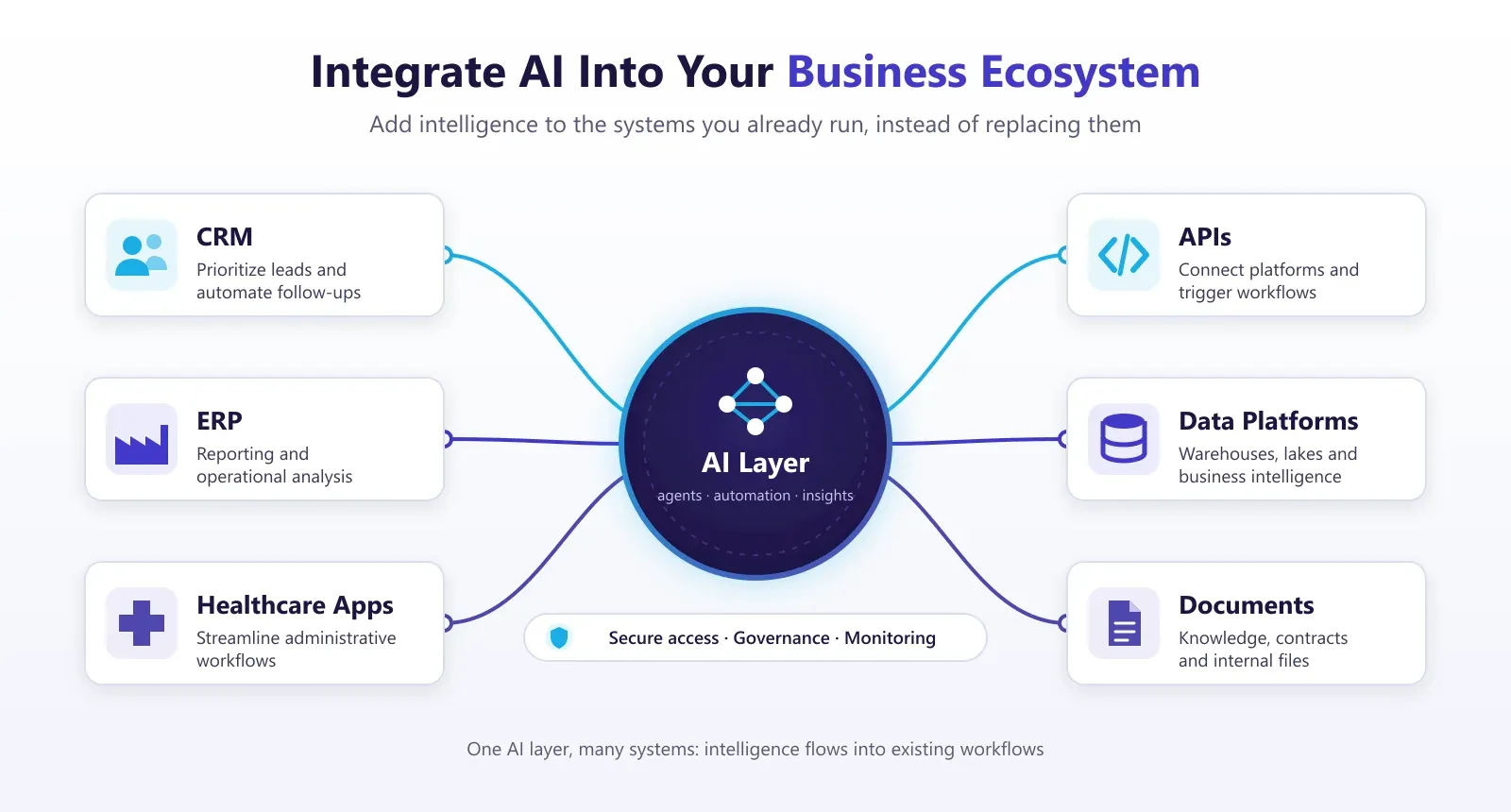
One AI layer, many systems: AI adds intelligence to the CRM, ERP, data and applications you already run.
For example, integrating AI with CRM platforms can help sales teams prioritize leads and automate follow-ups. Connecting AI with ERP systems can support reporting and operational analysis. Integrating AI into healthcare applications can help streamline administrative workflows and improve information accessibility.
A well-planned integration strategy allows businesses to introduce intelligence into existing workflows without unnecessarily replacing their technology investments.
7. Measure AI Success Through Business Outcomes
AI implementation should not be measured by the number of tools purchased or models deployed.
It should be measured by the business value created.
Organizations should define measurable KPIs before implementation.
| Business objective | KPI to measure |
|---|---|
| Improve productivity | Hours saved |
| Reduce operational costs | Cost per transaction |
| Improve customer service | Response and resolution time |
| Improve sales performance | Lead conversion rate |
| Increase automation | Percentage of automated workflows |
| Improve decision-making | Reporting and analysis turnaround time |
Tracking these indicators helps businesses understand whether AI investments are generating meaningful returns and where further improvements are needed.
8. Why the Right IT Partner Makes a Difference
Developing an AI strategy requires more than selecting a model or subscribing to an AI platform.
Businesses need expertise across technology consulting, cloud infrastructure, data engineering, cybersecurity, application development, and enterprise integration.
An experienced IT partner can help organizations:
- Assess AI readiness and identify opportunities.
- Define an AI adoption and implementation roadmap.
- Select suitable AI models and platforms.
- Develop custom AI applications and intelligent agents.
- Integrate AI with existing enterprise systems.
- Implement secure and private AI environments.
- Establish AI governance and monitoring.
- Continuously optimize AI performance.
The right technology partner connects business objectives with practical AI capabilities, helping organizations move from experimentation to real-world implementation.
Conclusion: Strategy First, Technology Second
AI is creating enormous opportunities for businesses, but successful adoption requires more than investing in the latest tools.
Organizations need to understand their challenges, prepare their data, establish security controls, select the right technologies, and define measurable business outcomes.
A well-defined AI strategy provides the direction needed to make these decisions confidently.
The future will not belong to businesses that simply use the most AI tools. It will belong to businesses that know where, when, and how to use AI effectively.
Don’t invest in AI just to keep up with the competition. Build an AI strategy that moves your business forward.
Ready to build your AI roadmap?
At Periscope Tech, we believe successful AI adoption starts with understanding your business goals and identifying the right technology opportunities. From AI consulting and intelligent automation to enterprise AI integration and secure AI solutions, the right strategy can help transform how your business operates.
Book 15 minutes
💬Discussion & Notes
Comments powered by Garrul.