
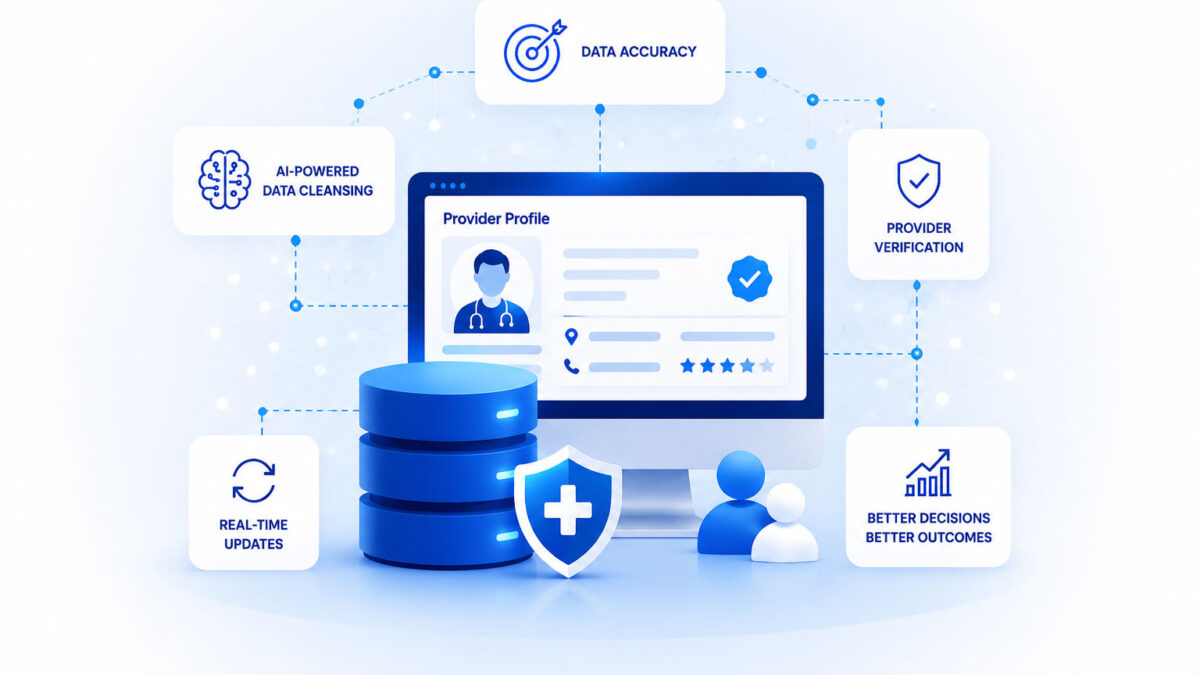

How AI Is Transforming Provider Data Management: The Foundation of Better Healthcare
Provider data is the backbone of every healthcare organization. From provider directories and credentialing to network management and patient search, accurate provider information is critical for delivering seamless patient care. Yet many organizations still struggle with outdated, duplicate, and inconsistent provider data.
Artificial Intelligence (AI) is changing that by automating data management, improving accuracy, and helping healthcare organizations maintain trusted provider information at scale.
Why Provider Data Management Matters
Provider Data Management (PDM) is the process of collecting, validating, maintaining, and distributing provider information across healthcare systems.
This includes:
- Provider demographics
- Specialties and subspecialties
- Licenses and certifications
- Practice locations
- Hospital affiliations
- Insurance network participation
- Office hours
- Contact information
- Languages spoken
- Telehealth availability
When this information is inaccurate, it can lead to delayed care, scheduling issues, denied claims, and poor patient experiences.
Common Challenges in Provider Data Management
Many healthcare organizations face recurring issues such as:
- Duplicate provider records across systems
- Outdated addresses and phone numbers
- Missing or expired licenses
- Inconsistent provider specialties
- Manual credential verification
- Disconnected data across EHRs, CRMs, and payer systems
- Frequent provider directory inaccuracies
- Time-consuming data maintenance
Managing thousands of providers manually is no longer sustainable.
How AI Is Revolutionizing Provider Data Management
1. Intelligent Data Cleansing
AI can automatically detect:
- Duplicate provider profiles
- Incorrect addresses
- Missing mandatory fields
- Conflicting provider information
- Invalid contact details
Instead of relying on manual reviews, AI continuously improves data quality through automated validation.
Benefit: Higher data accuracy with less manual effort.
2. Automated Provider Matching
Healthcare organizations often receive provider data from multiple sources.
AI can determine whether two records represent the same provider, even when:
- Names are spelled differently
- Addresses vary
- Credentials are incomplete
- Data formats are inconsistent
This creates a single, reliable provider record.
Benefit: Eliminate duplicate profiles and create a trusted provider database.
3. Real-Time Credential Monitoring
AI can monitor:
- Medical licenses
- Board certifications
- DEA registrations
- NPI information
- Sanctions and exclusions
When changes occur, the system can notify administrators immediately.
Benefit: Reduce compliance risks and keep provider records current.
4. Smarter Provider Search
Traditional provider directories depend on exact keyword matches.
AI-powered search enables patients to find providers using natural language queries such as:
- “Heart specialist near me who accepts my insurance”
- “Female pediatrician available this week”
- “Orthopedic surgeon offering telehealth appointments”
AI understands intent rather than requiring exact terminology.
Benefit: Faster, more intuitive provider discovery.
5. Automated Data Enrichment
AI can enhance provider profiles by adding:
- Spoken languages
- Clinical interests
- Publications
- Research activities
- Accepted insurance plans
- Telehealth capabilities
- Patient ratings (where appropriate)
This creates richer, more informative provider directories.
Benefit: Improved patient decision-making and provider visibility.
6. Predictive Data Quality Monitoring
AI continuously monitors provider data and predicts which records are most likely to become outdated based on patterns such as:
- Upcoming license expirations
- Practice location changes
- Contract renewals
- Affiliation updates
Instead of reacting to errors, organizations can address them proactively.
Benefit: Better data quality with fewer surprises.
7. AI-Powered Workflow Automation
AI can automate routine administrative tasks including:
- Provider onboarding
- Credentialing workflows
- Data validation
- Approval routing
- Directory publishing
- Change notifications
This reduces manual workload and speeds up provider activation.
Benefit: Faster onboarding and improved operational efficiency.
8. Continuous Compliance Monitoring
Healthcare organizations must comply with regulatory requirements related to provider data.
AI helps by:
- Detecting missing compliance documents
- Monitoring regulatory changes
- Tracking audit readiness
- Flagging inconsistencies before they become issues
Benefit: Stronger governance and reduced compliance risk.
9. Better Analytics and Insights
AI transforms provider data into actionable intelligence, helping organizations answer questions such as:
- Which specialties are underrepresented?
- Where are access gaps?
- Which regions need additional providers?
- How long does provider onboarding take?
- Which provider records require updates?
These insights support better planning and resource allocation.
10. Improved Patient Experience
Accurate provider data directly impacts patients by helping them:
- Find the right provider faster
- Verify insurance participation
- Access current office information
- Schedule appointments with confidence
- Receive timely care without unnecessary delays
Reliable provider information leads to a smoother and more trustworthy healthcare experience.
Business Benefits of AI-Powered Provider Data Management
| Benefit | Impact |
|---|---|
| Higher data accuracy | Fewer errors and duplicate records |
| Faster provider onboarding | Reduced administrative delays |
| Improved compliance | Lower regulatory risk |
| Better provider search | Enhanced patient satisfaction |
| Lower operational costs | Reduced manual effort |
| Smarter decision-making | Actionable insights from provider data |
| Stronger interoperability | Consistent information across systems |
Looking Ahead: AI Agents for Provider Data Management
The future of Provider Data Management extends beyond automation. AI agents can continuously monitor provider information, validate updates, coordinate approvals, detect anomalies, and synchronize changes across EHRs, CRMs, payer systems, scheduling platforms, and provider directories.
Instead of relying on periodic manual updates, organizations can maintain a continuously trusted provider data ecosystem that supports better patient access, operational efficiency, and regulatory compliance.
Conclusion
Provider data is more than a directory—it is the foundation of patient access, network integrity, and healthcare operations. As provider networks grow and regulations evolve, manual processes become increasingly difficult to sustain.
AI enables healthcare organizations to maintain accurate, up-to-date provider information, automate routine workflows, strengthen compliance, and deliver a better experience for both providers and patients.
Organizations that invest in AI-powered Provider Data Management today will be better positioned to deliver connected, efficient, and patient-centered care in the years ahead.
Website: https://periscope-tech.com/
Book Consultation: https://periscope-tech.com/contact
Email: [email protected]
