
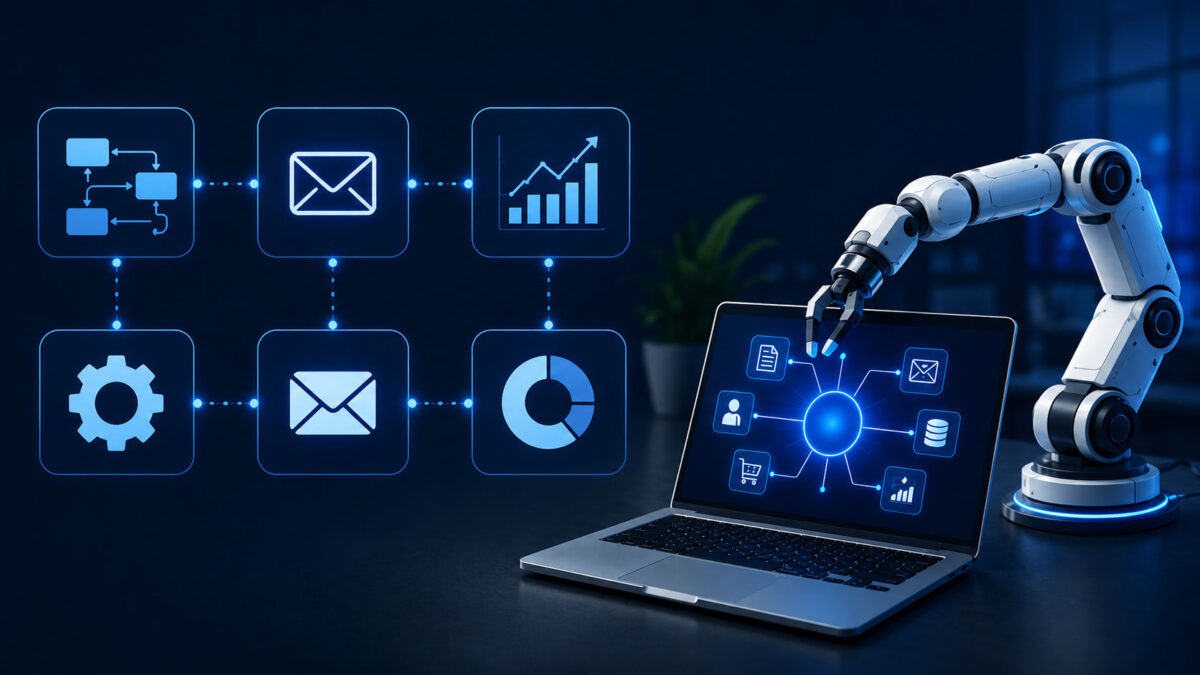

What Is AI Automation? A Complete Guide for Businesses
Introduction
AI automation is the use of artificial intelligence to automate business tasks, workflows, and operational processes that normally require manual effort or human decision-making.
It combines AI technologies such as machine learning, natural language processing, computer vision, and generative AI with automation systems to improve how work is handled across an organization.
Businesses are increasingly using AI automation to reduce repetitive work, improve operational efficiency, speed up execution, and handle complex workflows that traditional automation systems often struggle to manage.
What Is AI Automation?
Traditional automation is built around predefined rules and structured workflows. It works well when processes remain predictable and inputs stay consistent.
However, most business operations involve changing situations, different document formats, customer conversations, approvals, exceptions, and unstructured information.
This is where AI automation becomes valuable.
Instead of relying only on fixed rules, AI automation can understand context, process information, classify requests, extract data, generate responses, and support workflow decisions automatically.
AI automation helps businesses automate workflows involving:
• Emails
• Documents and PDFs
• Customer support requests
• CRM updates
• Internal approvals
• Data extraction
• Reporting workflows
• Operational coordination
• Ticket routing
• Workflow orchestration
Why Businesses Are Adopting AI Automation
Software automation has existed for years through tools such as robotic process automation (RPA), workflow automation platforms, and enterprise integrations.
But traditional automation systems often require significant manual setup and maintenance.
When workflows change, applications update, or data formats vary, many automation systems break and require reconfiguration.
This creates operational limitations, especially for large enterprises handling high volumes of data, customer requests, and internal processes.
AI automation helps solve these challenges by making workflows more adaptive and intelligent.
Instead of automating only repetitive clicks, businesses can now automate workflows that involve understanding information, processing requests, and coordinating actions across systems and teams.
How AI Automation Works
AI automation typically works through a connected workflow.
1. Information enters the system through emails, forms, chats, APIs, business applications, CRMs, or documents.
2. AI models analyze the information to identify intent, context, requests, priorities, or workflow requirements.
3. Workflow logic determines what action should happen next based on business rules, confidence levels, and operational conditions.
4. The system executes actions automatically such as updating records, routing approvals, assigning tasks, generating responses, escalating issues, or triggering downstream workflows.
This allows businesses to reduce manual effort while improving speed, consistency, and operational efficiency.
AI Automation vs Traditional Automation
Traditional automation works best for structured and repetitive workflows.
AI automation is designed to handle more dynamic and unstructured business processes.
Traditional Automation:
• Rule-based workflows
• Fixed logic
• Limited flexibility
• Requires predefined conditions
• Best for repetitive structured tasks
AI Automation:
• Context-aware workflows
• Handles changing inputs
• Supports intelligent decision-making
• Processes structured and unstructured data
• Adapts to workflow variations
Common AI Automation Use Cases
Businesses are using AI automation across multiple departments and workflows.
Sales Automation:
• Lead qualification
• CRM updates
• Follow-up generation
• Meeting summaries
Customer Support Automation:
• Ticket routing
• AI chat support
• Escalation handling
• Resolution recommendations
Operations Automation:
• Workflow management
• Document processing
• Approval routing
• Task coordination
Finance Automation:
• Invoice processing
• Reporting workflows
• Compliance checks
• Reconciliation support
IT and Cybersecurity Automation:
• Alert prioritization
• Incident management
• Threat analysis
• Investigation support
The Growing Role of AI Automation
Businesses are moving beyond basic task automation and increasingly integrating AI into operational workflows.
The goal is not simply to automate individual tasks.
It is to improve how information, decisions, approvals, and workflows move across the organization.
At Periscope Tech, we help businesses build AI-driven workflow systems that reduce manual dependency, improve operational efficiency, and support scalable enterprise automation across sales, operations, support, finance, and business workflows.
Website: https://periscope-tech.com/
Book Consultation: https://periscope-tech.com/contact
Email: info@periscope-tech.com
